
The Supreme Court of India has refused to entertain a plea seeking a ban on Salman Rushdie's controversial novel 'The Satanic Verses'. The court noted that the plea effectively challenged a previous Delhi High Court judgement.
The Supreme Court questions the government's reluctance to consider lethal injection as an alternative to hanging for death row convicts, highlighting the need for evolution in execution methods.

The Supreme Court has directed the removal of all cattle and other stray animals from highways and expressways, citing safety concerns and frequent accidents.
The Supreme Court has directed all states and Union Territories to report on the implementation of guidelines for addressing mental health issues and suicide among students in educational institutions. The Centre has also been asked to file a compliance affidavit.

The Supreme Court has directed authorities to relocate stray dogs from institutional areas like schools and hospitals to designated shelters due to a rise in dog bite cases. The court also addressed the issue of stray animals on highways.

Justice Bhushan Ramkrishna Gavai was on Wednesday sworn in as the 52nd Chief Justice of India.

'Some films are meant to more than just entertain you. They are meant to challenge, provoke, push you to think, instil change, and be in the public conversation.' 'That is Haq.'

The Supreme Court of India has dismissed the bail plea of former IPS officer Sanjiv Bhatt, who was convicted and sentenced to life imprisonment in a 1990 custodial death case. The court ruled that there was no merit in his plea for bail or suspension of sentence. Bhatt, along with co-accused Pravinsinh Zala, was found guilty of murder, voluntarily causing hurt, and criminal intimidation by the Gujarat High Court in 2024. The case stems from the death of Prabhudas Vaishnani, who was detained by Bhatt following a communal riot in Jamjodhpur in 1990. Vaishnani's brother alleged that Bhatt and other police officers tortured him in custody, leading to his death.
The application sought direction for 'X' to take down the video immediately to prevent further communal disharmony.

The Supreme Court has directed chief secretaries of states and Union Territories (excluding West Bengal and Telangana) to appear on November 3 to explain the lack of compliance affidavits in the stray dogs case.
The Supreme Court has stayed the execution of an alleged Indian Mujahideen operative sentenced to death in connection with the 2013 Dilsukhnagar blasts.

The Supreme Court will hear a suo motu case regarding the relocation of stray dogs in Delhi-NCR following widespread protests against an earlier order. A new three-judge bench will review the matter, focusing on the implementation of animal birth control rules and the creation of adequate shelters.
The Supreme Court has scheduled a hearing for November 12 to address the statutory age of consent for adolescents, emphasizing the need for a continuous and comprehensive examination of the issue. The Centre defends the current age of consent, while an amicus curiae suggests lowering it.

The Supreme Court has cancelled the bail granted to gangster Chhota Rajan in the 2001 murder case of hotelier Jaya Shetty in Mumbai, citing his history of absconding and convictions.

The Supreme Court has questioned the delay in the hanging of Balwant Singh Rajoana, convicted in the 1995 assassination of former Punjab CM Beant Singh, despite the Centre calling it a 'serious offence'.
The Supreme Court has raised concerns about the lack of oversight in the monitoring of CCTV cameras installed at police stations across India, suggesting a need for AI-driven, intervention-free control rooms.
The Supreme Court criticizes an accused in a CTET proxy exam case, referencing the movie 'Munna Bhai MBBS' and emphasizing the damage to the public examination system. The court seeks a response from Uttar Pradesh regarding the denial of bail to the petitioner.

The Supreme Court of India has emphasized the importance of aggressive sterilization programs to control the growing population of stray dogs, balancing animal rights with public safety concerns.
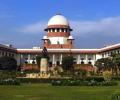
The Supreme Court has asked 'dog lovers' and NGOs opposing the permanent relocation of stray dogs in Delhi-NCR to deposit funds to be heard in the matter. The funds will be used for stray dog infrastructure.
The Supreme Court has raised concerns about discrimination against persons with disabilities in employment, questioning the Centre on the lack of 'upward movement' for meritorious candidates. The court also ordered nationwide monitoring of care institutions for persons with cognitive disabilities.

The Supreme Court of India has affirmed a child's right to the affection of both parents, even when they live apart or in different countries. The court ordered video interaction between a father and his son living in Ireland, emphasizing the importance of maintaining a relationship for the child's well-being.

A bench of Justices Vikram Nath and Sandeep Mehta also restored the destruction of evidence charge levelled on deputy commissioner of police Parampal Singh for directing the removal of the number plate of the car after the firing incident in 2015 in which a driver was killed.

The BJP has demanded the death penalty for former Congress MP Sajjan Kumar, who was sentenced to life imprisonment for his role in the 1984 anti-Sikh riots. The party's leaders have called for the CBI to appeal the verdict, saying it was not an ordinary murder case but a genocide. The BJP has also said that the "wheels of justice" are starting to turn and that other Congress leaders involved in the riots will soon face consequences.

The Supreme Court has agreed to reexamine the case of a death row convict punished for raping and killing a minor in 2008, focusing on whether sentencing guidelines were properly followed.
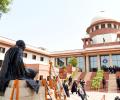
Calling itself the "custodian of the Constitution", the Supreme Court on Thursday asked if it could "sit idle" if a constitutional functionary like governor failed to discharge duties, as it reserved its verdict on the presidential reference on grant of assent to bills.

The Centre has argued before the Supreme Court that state governments cannot use writ jurisdiction to challenge the actions of the President and Governor regarding bills passed by state assemblies, particularly concerning fundamental rights violations. The President seeks the Supreme Court's opinion on whether states can file writ petitions under Article 32 and the scope of Article 361.

The Supreme Court of India has made public the asset details of its judges, including Chief Justice Sanjiv Khanna who has Rs 55.75 lakh in a fixed deposit, a three-bedroom DDA flat in south Delhi, and a four-bedroom apartment measuring 2,446 square feet in the Commonwealth Games Village. The court has also uploaded the complete process of appointments to the high courts and the Supreme Court on its website for public awareness.
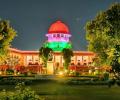
The Centre told the Supreme Court that governors are not indefinitely sitting on bills passed by state legislatures, and that barring a few exceptions, most have acted in a way which the apex court would have perhaps desired. Solicitor General Tushar Mehta argued that a Governor is "not a rubber stamp" and has a duty to preserve, protect, and defend the Constitution.

Chandrapuram Ponnusamy Radhakrishnan was sworn in as the 15th Vice President of India, succeeding Jagdeep Dhankhar.
The Supreme Court is examining the extent to which courts can intervene when governors delay or refuse to act on bills passed by state assemblies. The court questioned the Centre on whether judicial review is barred in cases of gubernatorial inaction, sparking debate on the balance of power between states and the central government.

'Ram Setu', also known as Adam's bridge, is a chain of limestone shoals between Pamban Island, off the south-eastern coast of Tamil Nadu, and Mannar Island, off the north-western coast of Sri Lanka.

The Supreme Court on Friday said a 'blanket direction' to pick up stray dogs in Delhi-NCR and place them in shelters without evaluating the existing infrastructure might lead to a 'catch-22 situation' as the directive might be impossible to comply with.
The Centre has opposed the imposition of fixed timelines on governors and the President for decisions on bills passed by state legislatures, arguing that such constraints were intentionally omitted by the Constitution's framers.
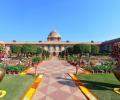
The Supreme Court has ruled that a Governor cannot send bills to the President for consideration if the state assembly has already cleared them for a second time. The court was questioning the Centre over the powers of the Governor when it comes to granting assent to bills.

"They (government) are taking good care of whatever is possible," the bench observed.
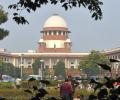
The Supreme Court is hearing arguments regarding a presidential reference on whether fixed timelines can be imposed on governors and the president for acting on bills passed by state legislatures. The court is considering objections to the maintainability of the reference under Article 143 of the Constitution.
BJP-ruled states argued in the Supreme Court that governors and the President have autonomy in assenting to bills passed by state assemblies, asserting that courts cannot mandate assent.
The Supreme Court has scheduled hearings starting August 19 for the Presidential Reference concerning constitutional issues related to timelines for handling bills passed by state assemblies. The court has directed the Centre and states to submit written arguments by August 12.
A Constitution bench comprising Chief Justice B R Gavai and Justices Surya Kant, Vikram Nath, P S Narasimha and A S Chandurkar, would fix the timelines on July 29 and commence hearing on the presidential reference in mid-August.

Its August 11 direction, which prohibits the release of stray dogs from dog shelters, shall be kept in abeyance for the time being, the apex court said.
 © 2026 Rediff.com - Investor Information - Advertise with us - Disclaimer - Privacy Policy - Sitemap - Feedback - About us - Terms of use - Grievances